I decided to check out The Memphis Murder Men after seeing that Misfit Mandy (@AcsGarza) had seen them recently. They are a rock and roll band based in Oakland but started in Pittsburgh, and you can reasonably call them punkabilly.
With at least some songs named after horror movies, and a combination of horror lyrics with old-fashioned music, it was hard not to think of the Misfits. However, they sound like they were influenced more by Elvis Presley than doo-wop. There is less of the soaring vocals of heartbreak, and more rocking guitar. That being said, they sound like they are having a better time than many doo-wop bands.
Listening to them has been very fun. As you listen harder, some of the lyrics become more questionable. Even though it does not sound like it is meant to be taken seriously, it can be uncomfortable.
(This is also a great deal like Misfits for me. Many songs are twisted, but the only one I can't get behind is "One Last Caress". For The Memphis Murder Men, that is "Girls Cant Say No". And maybe "Mister Fister".)
Nonetheless, there is a great deal of fun to be had, although I was left with one burning question. They call themselves "The World's 2nd Greatest Rock n Roll Band". I'm okay with that, but it makes me feel like I should know who's first, and I'm not sure.
I guess existential dread and feelings of uncertainty are a part of horror.
http://thememphismurdermen.net/
https://www.facebook.com/tmmmofficialpage
https://www.youtube.com/channel/UCR9-c9olXstbgzpJ2bAf0hw
https://twitter.com/MurderMenRnR
ETA: The band quickly responded that the 1st greatest band is the Ramones. No arguments here.
Friday, August 24, 2018

Thursday, August 23, 2018
Band Review: Murder On The Airwaves
Some of my favorite band reviews have been when bands from Manchester follow me, so I think I lucked out in being followed by Murder On The Airwaves.
Most of the songs are very fast and energetic - very punk - but there are songs that go more slowly and more emotionally. That was the case with "Never Gonna Be Alone" and "Ultraviolet" (Oddly, the song with "Ballad" in the title was not particularly slow.)
Still, I probably found "The Calldown" most interesting. It feels like it goes more places, with more of a journey. Murder On The Airwaves is fun overall, but they are more than fun too.
It looks like their events are pretty scattered, so if you get an opportunity to see them live, take it. Otherwise it could be several months.
https://www.facebook.com/OfficialMOTAuk/
https://www.youtube.com/channel/UC8VEk7N9-r4FI9uj-C6Budw
https://twitter.com/officialmotauk
Wednesday, August 22, 2018
The last straws
The movement to ban plastic straws was wrong in so many ways that it becomes interesting, as well as infuriating.
I know about the straw in the sea turtle's nose. I am not a fan of that. However, it was repeated many times that straws are only responsible for .03 percent of plastic waste, while fishing nets make up over forty percent of that waste. You know all those inspiring videos of divers freeing whales and beach goers freeing a giant manta ray from nets? Those happen because not only is that the bulk of the waste, but because by design it is something that entangles ocean life. No one has gotten excited about nets. I suppose it's because no celebrities have.
(There are people working on it. Here's one story: https://news.nationalgeographic.com/2018/06/heather-koldeway-explorer-nets-plastic-philippines-ocean-culture/
I really have nothing against celebrities promoting causes. Any influence you have should be used for good. To really do good, though, advance thought can really elevate the whole thing.
I have one friend who keeps a collapsible reusable straw with her, and specifies not wanting a straw when she orders drinks. She does not need any ban to do that. Lots of people who care deeply about that could do that without a ban.
Of course, that doesn't do anything about plastic cups and lids. Interestingly, drinking carbonated beverages through a straw limits the negative impact on teeth (probably the only reason my sisters still have theirs). There could be a lot to be said health-wise about limiting going to places that use plastic containers (often fast food places) and drinking pop, but okay, if we are not changing that, limiting straw use is one step toward a .03 percent decrease in plastic waste in the oceans.
I am still not against any of that, until the consensus becomes that not enough people will participate voluntarily (probably true), and so we need to make it mandatory (more questionable), and that effort ignores the voices of people with disabilities who say they need straws.
I know to some extent our lack of imagination on disabilities makes things worse; we picture a person in a wheelchair who has unencumbered use of their hands and throat and lungs and surely they don't rely on that straw. But any limited mobility could affect the ability to move the cup, various conditions affecting swallowing can also be a factor, and liquid intake matters. Lots of things can come into play.
For example, if your immune system is compromised, the reusable straws don't just need to be sort of clean. Assuming the dishwasher works, how many straws do you need to have between loads? One person I am thinking of who would not have been able to drink without a straw would have also had a hard time opening up and inserting the a reusable straw. Sometimes there is someone to help, but that's not guaranteed. Paper straws don't hold up well in hot beverages, but they also may not do well when spending a longer time in the beverage, which could be an issue for someone needing to drink slowly.
Okay, previously, I never thought about a straw as a life-saving necessity. You can call that able-bodied privilege; I haven't experienced it and I don't have to think about it. I only even know anything about it now because of seeing other people talking about it. I learned a lot by listening.
The sad part then becomes the passionate reluctance that so many others showed to listening. They were so sure that their solutions for a problem they never thought about were adequate. They were so skeptical about the possibility of there being needs other than their own. Then it is hard to know whether it is more infuriating that people can be so dismissive of the lived experience of others, or that they are doing it for an only .03 percent reduction in waste. I love turtles, but doesn't it make more sense to think bigger?
Except that the idea that caught fire was something that primarily hurts a marginalized group, whereas the ideas that would be more effective would involve asking businesses to do things differently, so really there was no chance it was going to go any other way.
(There are some things worth thinking about in there.)
So I want to go back to those last thoughts from yesterday's post. Imagine being told by someone that they would kill themselves if they had your life. Imagine the state saying that you can't have the pain meds that work for you, but assisted suicide is legal. Added on that, imagine people wanting to take away something that allows you to survive in order to make a tiny dent in a problem, but you are the one who's unreasonable.
One of the other things I saw in that thread about the suicide compliments (for lack of a better term), was someone who works in customer service, but they are in a chair due to a disability. Recently some customers were really nasty about it, but more common are the "friendly" jokes about sitting down on the job. All the time.
Forget whether you have anyone that you care about that has a disability. Forget whether age, disease, or injury will at some point change that. Is this good enough? Is this a way to treat people?
And if you can't care about other people, how much do you really care about the Earth?
Tuesday, August 21, 2018
The Shape of Water and representation
My main impression from The Shape of Water was that it didn't deserve Best Picture.
There were things that were really good about it. There were some amazing visuals and great performances, especially Michael Shannon's, but a lot of those elements did not fit together well, which meant that the overall viewing was jarring. Having only seen Hellboy for other examples of Del Toro's work, I would have to guess that he might have some issues with taste and self-indulgence that may hamper him despite having some visionary brilliance. (Kind of a George Lucas situation.)
Despite that, it was also jarring to read articles critical of the movie's portrayal of Elisa, who is mute. Here is one article that links to some of the others I have read:
https://www.huffingtonpost.com/entry/shape-of-water-offensive-to-people-with-disabilities_us_5a8b798de4b0a1d0e12c48fc
My initial quibbling disagreement is that her scars being a remnant of a violent act is an assumption. With her being found as an infant near a river, with the scars and inability to speak already in place, I thought it implied that she was also originally aquatic, and going off with the Amphibian Man was rediscovering her heritage. I base that on what I know of Pan's Labyrinth and the fairy tale tone set in most of the movie, including Giles referring to "the princess" in his narration.
So while I did not in any way think that was the intent or purpose of the movie, that did not automatically negate what people who actually live with disabilities took from the movie, including a confirmation that they need to go off and be with their own kind because there is not a place for them in this world. That was not right, and it was the kind of situation where you can't help but feel like having a few consultants with that actual disability could have been really helpful.
I found that despite thinking I kind of disagreed with the criticisms (it appears I was not that firmly rooted in my disagreement), I suddenly kept finding examples of disability being used as a prop.
The conversation around Natalie Dormer and In Darkness may have been part of it - one could find many examples - but the one I am going to focus on is the recent Portland Opera production of Faust.
I don't know who - for this version - first came up with the idea of putting Marguerite on crutches, but I ended up really hating it.
If the actress had actually needed crutches I would have applauded it. If it had been something that made me look at the character of Marguerite differently, resulting in new ways of thinking about the opera, I could have been pleasantly surprised by that. It was nothing like that.
This was how they used it: during one musical section she briefly did not need to use her crutches. I suppose the idea was to give an extra reason for how giddy Faust's love made her, and to remind the audience that he had infernal powers. It didn't feel that way though; it just felt weird. The reasons to be suspicious of Faust are the jewels and ways in which he presses boundaries. They showed that so beautifully in the 90s.
It also showed a difference in that when her spirit went free (because her body was executed) she no longer needed the crutches. Also done much better in the 90s. And I think there was one more reason for the crutches: to make her situation more pitiable. That was really uncomfortable.
Some of this may seem like it doesn't matter that much, but there are real people with real disabilities. If media finds that to be a fun concept for experimentation, without looking at the reality of situations, that is highly irresponsible. That has real-world consequences. If most of what you know comes from media depictions and they are false, what you think you know about those real people is false.
I am going to share two things I have read recently. I regret not being able to point to who said them. If I can find them later I will add the information.
One was in a recent thread on things that get said to people with disabilities. A frequent comment - paraphrased - is "I would kill myself if I had to go through that."
That may sound like a compliment, because you are so much stronger for being able to deal with it. Another interpretation is "I would not find a life like yours worth living."
On a related note, there was a different thread on the opioid crisis. One reaction to it is severely limiting and trying to completely phase out certain drugs that are addictive, but are also a real help for people with chronic pain. That includes some things they are looking at in Oregon. If our state policy is going to be taking away remedies for pain but leaving suicide available, what are we saying about some lives? That may not be the intended message, but you can send very damaging unintended messages when you don't think things through.
We are living in a time when Nazis are back. Some of them are openly Nazis, some of them are repeating slogans that they have to know relate, but I also hear people echoing things that Hitler wrote with no idea. ("We aren't intended to get along with each other" being a big one.)
Certainly, people who aren't deeply evil should be able to follow those nihilistic trains of thought and see the logical outcomes, be repelled, and reverse, but if you silence enough voices - not even thinking about it - it's possible to make it pretty far down the path.
I reiterate that representation matters. Yesterday and today are about disability representation, other times it will be about gender, race, religion -- humans find a lot of ways to marginalize and hate, and we need to get better than this. Sometimes we are horrible in remarkably stupid and pointless ways.
More on that tomorrow. For now, this seems relevant:
https://www.ushmm.org/information/exhibitions/online-exhibitions/special-focus/nazi-persecution-of-the-disabled
Monday, August 20, 2018
The Schneider Family Book Awards
The award is donated by Dr. Katherine Schneider, and honors an author or illustrator for a book that embodies an artistic expression of the disability experience for child and adolescent audiences.
I only read the picture books, but I was able to find several and ended up reading more. I am going to go over my reading choices, and then give some thoughts at the end.
Six Dots: A Story of Young Louis Braille, written by Jen Bryant and illustrated by Boris Kulikov
This was one of the best written and most interesting. It's not unusual to know that Louis Braille invented the alphabet that allows vision-impaired people to read with their fingers, but in addition to learning more about him, you see how family and community support helped him and how existing patterns inspired him. Excellent.
The Pirate of Kindergarten, written by George Ella Lyon and illustrated by Lynne Avril
One of the most interesting things for me was seeing how it could be difficult for a child with a perceptual difference (in this case, double vision) to know that there is a difference and to know how to communicate it. A vision test was helpful, but if they had only tested both eyes separately, it could still have been missed. Good food for thought. A bit where she had to navigate chairs, and she knew that only half of them were real but not which ones, really hit home.
Silent Days, Silent Dreams, written and illustrated by Allen Say
This focuses on the life and art of James Castle, born profoundly deaf and probably also dyslexic. In this case there was more of a lack of family support, but they could not stop him from making art.
Back to Front and Upside Down, written and illustrated by Claire Alexander
This could apply to dyslexia, or a child just temporarily behind the rest of their class. It works well for helping children know that it is okay to have trouble and to ask for help, and is written with a lot of empathy.
Emmanuel's Dream: The True Story of Emmanuel Ofosu Yeboah, written by Laurie Ann Thompson and illustrated by Sean Qualls
This is a truly inspiring story, as Emmanuel finds ways to get around, make friends, and help support his family, then to raise awareness to help others with disabilities. I really liked the illustrations. Looking more at Sean Qualls' work there are some really interesting titles, so I look forward to seeing more by him.
The Deaf Musicians, written by Pete Seeger and Paul DuBois Jacobs, illustrated by R. Gregory Christie
This was not as based in real experience, and I think suffered a bit for that, but I know that there are musical elements that come into play with sign language, and that rhythm is not limited to hearing, so those points are valid.
A Splash of Red: The Life and Art of Horace Pippin, written by Jen Bryant and illustrated by Melissa Sweet
Pippin's story, which includes retraining his ability to do art after losing the use of his arm to a war injury, is inspiring. While his art is very respected in the illustrations, I am not sure that the book will do well at capturing children's imaginations. It might be better to rework the material for an older audience.
Piano Starts Here: The Young Art Tatum, written and illustrated by Robert Andrew Parker
Some of the same issues as the book on Horace Pippin, though there is one scene with lightning bugs and a summer night that is captured beautifully.
A Boy and a Jaguar, written by Allen Rabinowitz and illustrated by Catia Chen
Allen Rabinowitz is himself a stutterer who works for jaguar conservation, and this is his story of learning how to work with his speech impediment and follow his dream. Very inspiring, and a breathtaking ending.
Django, written and illustrated by Bonnie Christensen
I saved this one for last for reading, because I love Django Reinhardt and I wanted to love this book, but it was not as magical as I'd hoped.
One of my big takeaways from the reading was that the amount of support someone with disabilities receives can make a huge difference. There were some wonderful families and some terrible families here.
The other thing - and it was probably evident from how I wrote about them - was that the quality of the books varied widely. It doesn't even mean that the worse ones were bad. Sometimes there are little things, like a paragraph that is too long for a children's book, or an interruption of the flow, where reading the book is fine but you wouldn't expect it to win awards. This was especially noticeable with the music books for me, because in other awards lists I saw some fantastic methods for conveying music visually, and it wasn't quite happening here.
I feel bad saying that, because it was clear that many of the writers and illustrators had a lot of passion for their subjects, and I know they wanted to impart those same feelings.
Personal experience matters. In the case of A Boy and a Jaguar, he did not come across as an experienced children's writer, but because it was his own story, that elevated it. I think The Deaf Musicians needed people who were deaf, not just people who cared about deafness, as the writers.
It seems clear that if books that are just okay are winning this award, there probably aren't that many books to choose from each year, so that brings us back to representation. I know there are lots of different types of disabilities and experiences with them, and there is clearly a lot that is not being covered. We should do better than that, but also to do it well, more people with disabilities need to be encouraged to tell their own stories. Because children's books have some specific needs, there can be room for mentoring here.
Let me repeat that representation matters, because we are going to spend some time on that tomorrow.
Friday, August 17, 2018
Band Review: Amanda Shires
Amanda Shires is an Americana musician from Texas with a long career for her relatively young age. At 36, she has been playing professionally since the age of 15; more than half of her life.
I was not previously aware of her until hearing about some reviews for her new album, To the Sunset. Coming at this review with fresh eyes, it has been interesting to spend time on her four most recent solo albums, spanning from 2011 to today.
It is hard to imagine anything prettier than "Sloe Gin" and "Kudzu", from her 2011 album, Carrying Lightning. The songs are beautifully accented with violin, which Shires has been playing since ten.
Those songs are the ones I responded to the most while listening. I nonetheless appreciate an evolution over time as other styles and instruments have been incorporated. Guitar has become more pronounced - and more electric - over the course of the albums. To the Sunset's cover photo has a blurred and alien look. The opening track, "Parking Lot Pirouettes", starts with some distortion, and feels more plugged in than her earlier work. There is musical growth, which I appreciate.
There is still a continuity of feeling and heart, and a connection the past. "A Song for Leonard Cohen" is present, but knows its roots.
Shires has an interesting voice, resonant but also bird-like, somewhat reminiscent of Dolly Parton. Between that and violin and guitar, there are good combinations of melody and harmony.
There are several performances scheduled between now and September 30th, giving a good chance of catching Shires on the road. If that is not possible, it is certainly reasonable to check out To the Sunset, but it would be a shame to stop there. As an artist she has a lot to offer.
http://amandashiresmusic.com/
https://www.facebook.com/AmandaShiresMusic/
https://www.youtube.com/channel/UCH2bj8PyLGgwEhtr55CUzUw
https://twitter.com/amandashires
Thursday, August 16, 2018
Band Review: Hightown Parade
Hightown Parade followed me last month. I am reviewing them earlier than I usually do, but that's how the schedule worked out.
There are currently only two songs available, but they are both really good. From the band's own description, one of the things they claim is "a vigorous dialogue between guitar and piano"- which is thoroughly established on "Choose".
Then you don't really hear the piano on "Silhouette". It doesn't need it because the guitars are fantastic, but comparing the two songs - and only having those two - makes you wonder where the band is going to go. Many good directions seem possible.
Overall I like the band's energy. It comes from all directions on instruments, but it is hard to overlook the intensity of Chris Payn on vocals. I get some flashes of a young Michael Hutchence, though I would not say that Hightown Parade sounds like INXS.
They do sound good, nonetheless, and worth keeping an ear on. They have several dates scheduled in England for November, available on the band's Facebook page.
https://www.facebook.com/HightownParade/
https://www.youtube.com/channel/UCIT3s727rWxAgXRGzvcoPuA
https://www.lyricsdb.co/hightown+parade/
https://twitter.com/Hightown_Parade
Wednesday, August 15, 2018
Honestly loved
A month and a half ago, someone told me he loved me and I told him that I loved him too.
There is a limit to the amount of detail I am going to give on that, but I will give some background.
We have known each other - without frequently being around each other - for five years. I was attracted to him but learned he was married so was mortified; both for not realizing it and then just for having the feelings. I worked really hard to get over that, and then when I could just like him as a person it was a relief. (He never knew any of that.)
Two fairly significant changes along the way included him getting divorced and my non-platonic feelings coming back hard. The latter had no influence on the former, but the former probably had something to do with the latter.
We happened to see each other twice within a few months, which never happens. The first time, although I did not confess love or anything like that, I did overshare and then felt really weird and stupid about that. In retrospect, I think the overshare - which was essentially admitting that my life is super hard right now - allowed him to also open up about his own problems, and that might be how we got to "I love you."
There is a lot that is up in the air there. We probably should have talked more that night, but it felt so heavy, and there was so much else going on, that there is still a lot to be said. There are a lot of obstacles, including but not limited to us both being at low points in our lives with lots of obligations and not lots of money and also about 2600 miles between us, so don't get too excited.
At the same time, I've had my fair share of euphoria with it. I can be doing many other things, mostly staying on track, but there is still a chorus of his name in my head. There is the memory of him saying "I love you." There is the concern sometimes that I said it back a little too immediately and adamantly. However, there is also the fact that as implausible as it was, when I was anticipating seeing him that night, among the many thoughts that went through my head was "You know, it's important for a lot of guys that they are first to say 'I love you', so you should let him go first." It hadn't seemed like an immediate need.
There is a lot to be figured out, and to think about, but what I want to say most at this point is really about me.
People who have been reading for a while know that I have really been trying to work on myself, and heal, and be better, and a lot of that has really started to come to fruition this year. I tend to believe that if the healing had not happened, then this could not have happened.
I don't mean to make any grand claims; I know that people with gaping holes in their self-esteem end up in relationships all the time, but I haven't. If me being open the last time that we saw each other allowed him to be open this time, I was only able to be open because of some of the things I'd worked through. And all of that progress is what allowed me to just reciprocate his love instead of possibly saying and definitely thinking "Why? Aren't you worried you can do better?"
(Which would be a terrible thing to say to someone you love who loves you, but it is a place that is mentally easy to go.)
My life started with a sense that there was something wrong with me, and at 14 it crystallized into understanding that I was fat and no one could ever love me, and especially if a boy seemed to love me it was a joke. I tried to compensate for that by being really good and helpful, but my main hope was that some day I would lose weight. None of the attempts worked, but I just wasn't good enough yet. Someday I would make it, and then I could have love and it would be okay. I loved people, but I kept my hope locked up and hidden, and repeatedly failed to lose weight.
At 31 I let my guard down and hope in, but I was wrong. The confirmation that the years of boxed up pain and fear were right made me want to die. Eventually I got to understand that was wrong, but believing it, and acting like it, was still really hard. It took me until 46. The real progress probably didn't start until 41, with depressed teen girls and the long reading list and My Chemical Romance. It's taken reading, and writing, and praying, and a year of selfies, and learning to let myself say "I hate" and be angry. All of that just to be able to say "I love".
I have had my fair share of doubts - "What if he just meant that he loved me as a friend?" And that would kind of suck, but it wouldn't break me the way the false hopes at 31 did. I am better now.
You cannot know how much it means to me that he told me he loved me in this state: broke, fat, and so utterly me. I have never been super cute, but I have been better looking than this. I have definitely been better off financially than this. The only thing to be into now is me. Somehow that is still worthy of being loved. I know it's right now too, though I still understand that not everyone gets it.
When I saw him in March, he asked me something that got me thinking, and I had some important realizations there. This time what he told me did too. Whatever happens from here, he has been good for me. I think I have been good for him. We could be friends.
And I don't want to be only friends; let's not have any lack of clarity there. But for while we are in this in between time, even if nothing else happens, I am happy that this happened. I love the euphoria, and I love the more practical realization of how much I have grown.
Tuesday, August 14, 2018
My Twitter moment
Okay, it wasn't really my moment; I was just a part of the moment.
It started with a tweet in January from @_EmperorJustin_ (I don't know him): "Still haven’t forgiven Zooey Deschanel for what she did to Joseph Gordon-Levitt in 500 Days of Summer."
It did get a fair amount of likes and retweets, and he pinned it, which may account for Joseph Gordon-Levitt seeing it and quote-tweeting it on August 6th:
"Watch it again. It’s mostly Tom’s fault. He’s projecting. He’s not listening. He’s selfish. Luckily he grows by the end."
This resonated with a lot of people, but it is also something I had thought about a lot. I could see that Summer was being very insensitive and callous, but she had been honest about her intentions, and Tom was the one who'd said he was okay with casual. I added my two cents:
"It's true that he lied about being okay with casual, but I think a lot of people relate to that, hoping the other person will change their mind. It may be the realest thing in cinema that she doesn't."
https://twitter.com/sultryglebe/status/1026538687461351425
That got a lot of traffic. To date it has 104 retweets and 2077 likes. That is huge for me. I think it was still around just 1000 likes when I got the Twitter moment notification.
For some perspective, Joseph Gordon-Levitt's tweet got 45000 retweets and 177000 likes, but also he has 4.2 million followers to my 1322 so the reach is completely different anyway. Part of what made it interesting for me is that I don't think there are any of my followers in those numbers. If they are, they are a small percentage. But that's the thing, the moment is about that thread and movie, not about me. (It is a bit about Joseph Gordon-Levitt).
Currently there is a thing going on now where if someone has a tweet blow up, they will add a link to their Soundcloud, or if they don't have one, maybe they will promote a charity or something, because people are looking. I had just joked about that on July 30th, tweeting that I do have a Soundcloud but I wasn't sharing it yet because the protocol is to wait until a tweet goes viral. Ah, so this is what that feels like.
I still didn't share it. That is partly because I am not sure that the logic works out. Yes, a lot of people have looked at it, but by the time I realize it is happening it could be mostly over. If the momentum is still going, maybe more people will come, but them being interested in the one thing doesn't mean that it will carry over to other things.
(Also, at this time my Soundcloud has exactly three short songs that I did for the Music for Wellness class. At some point I hope to put up other things, but sending people there now is not likely to cause them to want to revisit it.)
What really made me interested in this moment - other than my normal tendency to notice something and be curious about various aspects (especially quantifiable things) - were the replies. I get that a lot of people relate to being more into someone, and hoping it will change; many likes were because of that. The other part, though, about how real it is that it doesn't work; that was more interesting. I didn't even realize how much I meant it until I typed it. That is not how we expect movies to work, especially when it's about a likable man in pursuit of his dream girl.
(A good reply from @_youngTenderoni has 865 likes and 14 retweets.)
There's a whole bunch there, including how dream girl sounds more natural than dream woman, yet man still sounds more right than boy. There are ways in which it might be perfect that the quintessential manic pixie dream girl herself, Zooey Deschanel, was cast as Summer.
For my own thoughts, I worried that forget the Soundcloud, I should post a clarification that I didn't endorse Tom's self-deception. I did not add any thing to it. That tweet did pretty well as was. I don't need to add anything to it, but I still wanted to blog about it.
What I am really left with in doing that is the importance of honesty in relationships, of course, but what is so necessary with that is to be honest with yourself. Tom certainly knew that he wanted a deeper relationship with Summer, but he also might have told himself that he would be okay with casual. It seems pretty clear that he did not stop to honestly assess how he would deal with the one-sidedness of the relationship. It allowed for great moments, and an awesome musical number, but there was also a lot of frustration and pain, and him being a real jerk on that other date.
It's not like it's off-brand of me to write about the need for introspection and honesty and really knowing yourself and then acting with integrity based on that. This still seems like a good chance to do it again. If you can know yourself and your needs and your limits, you can build a better relationship with someone else. If you can honestly know that the attraction you feel - no matter how intense - will not prevent some things from being miserable, then you can make honest choices about how to proceed. There can be less hurting of other people and less setting yourself up for pain. It doesn't mean there isn't going to be any pain, but it helps.
And tomorrow I shall write a little bit about where that has gotten me, not with all of the details but still with some juiciness.
Monday, August 13, 2018
Black Panther as political commentary
It was the giant vibranium deposit - from a meteorite - that allowed Wakanda to become so technologically advanced, but it was their geographical isolation that saved them from colonialism.
Hiding their advanced technology made sense as a way of keeping colonizers and others interested in exploitation out, but it had never occurred to me that their isolationism meant not interfering in the slave trade.
Honestly, that seemed to be more of a movie thing, as I believe in the comics the real technological advances did not come until the time of T'Chaka, T'Challa's father. Even if that can't be quite as long ago as WWII-era now (if you do the math), it would still be well after the Atlantic slave trade and most of colonialism. The movie implied that Wakanda had watched all of that and let it happen to remain protected, which at least for me gave kind of a sinking feeling. Still, you had a smaller and more recent example with Killmonger.
In the movie, T'Chaka's brother was in America, and was selling vibranium in order to fund Black liberation groups, putting Wakanda's privacy at risk. Zuri came to return N'Jobu to Wakanda, but he resisted and was killed. A young Eric (N'Jadaka) returned to find his father dead.
I suppose it is logical that this Killmonger would be against both the colonizers and the royal family. When dying, he asks to be placed in the Atlantic, along with those who did not survive the Middle Passage.
Understandable, but the path that has gotten him there has involved training with the CIA and sowing turmoil in many countries on the behalf of the government. His body is covered with scars commemorating his kills. His ultimate plan is destruction and chaos. After he takes the heart-shaped herb he demands that the rest of the herbs be destroyed. There is no plan of succession; a hallmark of fascist leaders. While he will gladly destroy many who have held back others of his race, there is no reason to believe that there is a plan for after that. It is ultimately nihilistic.
I can feel sympathy. His father's death was a great loss at an impressionable age. One of the things I hate most in the books is when Preyy (a leopard he has bonded with) dies. Killmonger had been on his way to something better, and it seemed like it could work until that relationship loss. No one doubts that he has suffered, but it has caused him to lose empathy instead of growing it.
(There is a good Atlantic article about this: https://www.theatlantic.com/entertainment/archive/2018/02/black-panther-erik-killmonger/553805/.)
Unsurprisingly, this makes Black women his frequent targets, shooting, choking, and stabbing them, even the one who loved him. Mainly what I think of with him is that the master's tools cannot be used to destroy the master's house.
But for all his wrongness, it doesn't mean that the questions Killmonger raises are wrong. What is our responsibility to each other? How much do we put ourselves at risk to save others?
Sometimes those questions have difficult answers (though it is hard not to think that providing a home for the little boy they just orphaned could have been a good start). We have another example, though, with Nakia.
She is also against the isolation, but for her that means going and rescuing some kidnapped girls, and paying attention to a young boy among the kidnappers who may not be hardened yet. She starts with her knowledge and her abilities and goes to make a difference. She is also the one who rescues one heart-shaped herb, respecting tradition and hoping for the future while she does something concrete in the present.
It should be a completely obvious thing, but the world is turned upside down now, so maybe it isn't. Destruction needs to be healed, not amplified. Taking down tyranny can be fine, but has it ended misery, or are people still hungry, poor, and sick?
The traditional Masai greeting and response is an inquiry about children:
And how are the children?
All the children are well.
That can even be exchanged among childless people, because it's not about specific individuals, but that for things to be well, the children must be well.
To change what is wrong, that's a good starting place.
Friday, August 10, 2018
Band Review: Culture Abuse
This is my second band with a fuzzy sound this week. I would call it a coincidence, but both bands were recommendations, and the guys who recommended them have played together, so that probably makes it less surprising.
In this case, Culture Abuse was recommended by Gerard Way, but I remember seeing praise for their 2016 album Peach from many people (a sad reminder of how long some bands languish on the Recommended list).
Having listened, I totally get the praise for Peach. It starts in with an infectious energy on "Chinatown" (the band is based in San Francisco), moves right in to "Jealousy" - probably my favorite track - and stays strong all the way through a solid conclusion of "Yuckies" and "Heavy Love". Therefore it is not just that the individual songs are good, but also that the arrangement and the connections build well, something I always appreciate.
As good as Peach is, waiting to review Culture Abuse means that I can also include Bay Dream, which I believe is thematically stronger. Maybe it is just more personal.
The fuzz of the sound does make me think of some emo, but what it reminds me of most is punk. They would not be defined as punk based on tempo or reliance on a few simple chords. (At least I don't think so; my ear isn't really good enough to tell.) However, I feel a combination of sad subject matter becoming musically celebratory. Without being able to tell you that a single song sounds like the Ramones' "Beat On The Brat", that is what I think of: this sucks but we are all right. The need for that music never goes away.
I especially want to recommend "Calm E","Peace On Earth", and "Dave's Not Here (I Got the Stuff Man)", even though I think that last one is a drug reference.
I can really imagine fans of Weezer enjoying Culture Abuse, but also - and I'm probably only thinking it because of "Bluebird On My Shoulder" but that doesn't mean it's wrong - fans of They Might Be Giants.
Or, you know, fans of good music, but that's sort of unhelpfully broad.
Culture Abuse has tour dates starting September 7th. Check them out.
http://cultureabuse-uncensored.com/
https://www.facebook.com/cultureabusefanzine/
https://www.youtube.com/channel/UCHhawUGf_T7aRH-xIWTYfNQ
https://cultureabuse.bandcamp.com/album/the-day-dreams-of-nothing
https://twitter.com/cultureabuse
Thursday, August 09, 2018
Band Review: Cooler
Cooler was recommended by James Dewees, whom I believe got to see them live in February.
The Buffalo-based indie-emo band has a 2016 EP called Phantom Phuzz, and that title may contain the essence of the band.
It's not just the use of distortion, though that is noticeable. It is also the way some songs trail off (especially on "Nostalgia"), and how sometimes things sound far away; there can be ghosts out there, and you may hear them in the songs.
That is not that the tracks sound particularly supernatural either. It is more a sense of past and memories and feelings that have been unresolved being pulled forward. There is pain, but it can be released.
I enjoyed the older tracks, but 2018's Buried EP is strong. I especially liked the title track and "Quadrillion". For Phantom Phuzz, "Metal Moths" is pretty cool.
One point of clarification: I was first directed to bass player Alley's Instagram, @coolermood, and initially thought that was the name. If you search on "cooler mood", you get led to a different Bandcamp page, for Philadelphia band Small Circle. (And hey, I might just end up reviewing them too, so it's not a problem, but the name of the band is this review is just Cooler.)
It's worth noting that while Buried and Phantom Phuzz can be found in multiple sources, it looks like 1993 - with the pretty rocking "Stay" - is only available through Cooler's Bandcamp. Also, whenever I clicked play on an EP on Bandcamp, it would skip the first track, so click on the first track for complete listening.
That's all I've got! Relevant links are listed below.
https://www.facebook.com/cooler.music
https://cooler.bandcamp.com/
https://www.youtube.com/channel/UCqhn_8q3h6QaYQw2XoA4_Mw/feed
Wednesday, August 08, 2018
Black Panther as celebration
There were two other ways in which the movie improved on the comic books (in my opinion, obviously).
While I initially liked Ross in the books, he gradually got more whiny and more annoying. Learning that he was based on Chandler but named after Ross made total sense, but it didn't help. When Martin Freeman was being such a prig in Captain America: Civil War I was glad to know that Ross tends to receive a lot of aggravation. It felt like he was going to deserve it.
Seeing him terribly vulnerable, amazed, excited, and rising to the occasion later all worked to let me find him likable. Probably him taking the horrifying injury for Nakia should have done it, but really it was everything after that. (One reason I would really like to watch the movie again is see if it was necessary. I'd kind of be surprised if she needed the help. It seemed like she did, but it all happened pretty fast.)
That amazement as Ross viewed Wakandan technology leads to the other correction.
In the books they always referred to Wakanda as the most technologically advanced nation on Earth, but in the movies everyone was expecting them to be backwards. In the world of the movie, it made a lot more sense that they could be so technologically advanced and keep it totally hidden. You literally saw the mechanisms in place that did the hiding and they were remarkably effective and visually stunning.
In this landscape it was also possible to believe that all the Wakandan citizens were doing well with the technology; not just some. Even the Jabari - who had separated themselves from the rest of society - seemed to be doing fine.
I mentioned yesterday that in the books T'Challa was too perfect, and that it made everything else worse. Part of that was that one of T'Challa's strengths was that he was always ten steps ahead of everyone else, but he still needs conflicts for dramatic purpose, so really messed up things happen that wouldn't be predictable. Also he is always in the States being an Avenger but needs to come back because there are terrible problems in Wakanda. Based on the things they say about Wakanda, it should be better run.
Much of that goes back to the problem common to superhero comics in general - why don't all of these powers fix anything? The stories keep getting bigger and bigger and repeat and it doesn't seem to get anywhere, until it becomes so obvious that you reboot everything - it gets frustrating.
In the case of Black Panther I believe there were extra constraints because of a desire to present Africa and T'Challa positively, but then not knowing how to keep that balanced. (Hence too much annoyingly imperfect Ross. Also, there were probably some issues with internalized racism.)
Therefore it is an incredible triumph to see a strong African country not stunted by colonialism. It was a joy to find the Dora Milaje accomplished and fierce, but still able to have personal lives. It was important to see textiles inspired by kente cloth and traditional beading techniques and tattoos and even lip disks. (Ruth Carter is the best and there is more on that at https://www.theatlantic.com/entertainment/archive/2018/02/why-fashion-is-key-to-understanding-the-world-of-black-panther/553157/.) A lot of the cast and crew were American, but the movie is gloriously and purposefully African, and it's needed.
A friend asked me if I had seen anything focusing on the women in Black Panther, because they are so awesome. Everything that did was specifically focusing on Black women, because that is a more significant niche in this case. Black women do not get enough love, but this movie loves them.
(Speaking of the women, does anyone know if Ramonda is still the stepmother, or is she just the mother? I was never sure that her being the step-mother served any purpose except as a red herring to believe she could be conspiring against T'Challa.)
And that makes two more things about the movie that I mentioned yesterday more significant.
I prefer the movie's Nakia not merely because I love Lupita Nyong'o', but because I was glad to have all of the Black women be positive figures. I was glad to have the ridiculous villain be Klaue instead of Achebe not only because I am not sure how his puppet Daki would translate to the screen, but also because it is appropriate here to have a white villain, and to have him fall to the Black villain.
But Killmonger is going to need his own post.
Tuesday, August 07, 2018
Black Panther as an adaptation
Let's talk about movies a little.
As exciting as the Black Panther movie sounded, I had concerns about seeing it because I have never liked the books that much. That was a foolish worry; it's when you adore books that adaptations fill you with rage and disappointment!
Regardless, this worked well, and I wanted to spend some time on why it worked for me.
(There are some spoilers here, but even more there geeking out comparing the comics to the movie that may not make sense to people who have not read the books.)
First of all, for successfully incorporating comic book fantasy into a movie, I loved the way the absorbed energy was displayed in the suit. Being able to store the power of absorbed attacks is a cool idea anyway, but then as the purple potential energy spread it built excitement for the upcoming release of kinetic energy. It's a minor thing I suppose, but I thought it worked well.
Little touches can mean a lot. One of my favorite laughs was when Ross asks Klaue if he has a Soundcloud; he thinks he is being sarcastic, but he isn't. In a few years that joke may not be funny, but then it was. Also, it made Klaue goofier, which meant that they didn't need Achebe to get that element in. Honestly, I think it would be hard to make Achebe work onscreen. With Klaue as one type of danger, and Killmonger as another, the antagonistic elements were well-balanced.
Speaking of changing up your villains, the biggest change was Nakia. Instead of being the love-obsessed but kind of doomed to it villain, here Nakia is basically Storm, but with highly trained warrior powers rather than mutant powers. Recent mergers could allow X-men crossovers, but I like this Nakia.
To fix her they had to fix the Dora Milaje, and they did. It was in Queen Divine Justice's arc that the books really showed what a twisted position it is to be a Dora Milaje, not even being allowed to speak to other people, intended for the prince, but never really going to be with the prince. It's a horrible situation, and only really works as a male fantasy.
Here they are highly dedicated warriors, but they have their own lives too. They may choose their jobs over their husbands under the right circumstances (like if your husband chooses Killmonger over T'Challa), but it still seems like a much better life.
(I love Okoye!)
The movie Nakia has been through that training, but left to do more good and serve a broader purpose. I like that she inspires T'Challa but also leaves him with a weak spot.
That leads to the best part of all: I loved Shuri.
One of the things that never worked for me in the books is that T'Challa is too perfect, but without it paying off. He eventually solves problems but they keep coming up, but it isn't from personal weaknesses because they stripped all of those away. It makes everything else in the fictional world worse.
It's amazing how much a teasing little sister can lighten up a dourly idealized hero. I know she does appear in some books, but I have not read any of those. I hope she lightens up the books as much as she does the movie, but at least she does lighten up the movie.
I think I want to appreciate the movie from a different direction tomorrow, but first of all I am going to mention the part that I completely missed the significance of until later, because I admit my weaknesses.
I stayed for the after credits scene. I heard White Wolf and thought "cool". I understood that it gave a context to Shuri's line about T'Challa bringing her another broken white boy.
I did not recognize that he was Sebastian Stan. I just got curious later about who played him and looked it up. Oh. I guess he's unfrozen now.
At least it made sense when I saw Infinity War.
Monday, August 06, 2018
Instagrammed
Back in 2012 I got onto Twitter, almost accidentally. I got onto Facebook in late 2008, though that was deliberate. I'm just not really an early adopter when it comes to social media. Anyway, I am now accidentally on Instagram.
Maybe "accident" is the wrong word, but "on" is probably incorrect also. Let me explain.
I got onto Twitter because public figures that I was interested in were not on Facebook. Some people that are on Twitter also seem to use Instagram more, and do more interesting things with it. I would often click on links to photos. At one point I even looked into creating an account, but you needed to download the application to your phone. That required choosing which version depending on your phone type. My internet access is all through a PC, so an account clearly wasn't meant to be, but I could still click on tweeted links.
A few days ago I clicked on one link, and I got curious about something related. I clicked on something for the profile that posted that picture and was prompted to log in, but there was also an option for signing up.
Without having the app, I found that interesting. Yes, you can sign up on a PC, without installing anything. Then the fun part was finding that all my logins were already taken. Granted, it was six years ago, but one of the reasons the phrase "sultryglebe" appealed to me was that I didn't think anyone else would be attached to it. It worked for Twitter, but not for Instagram. I had not intended to be "sporktastic" on Blogger; it just happened after everything else I had thought of was already in use.
I ended up as "thesultriestglebe", which I now have sincere doubts about that, especially as I almost immediately started gaining followers. (They all appear to be people I already know via Facebook or Twitter).
I have been thinking about exiting Facebook for some time, based on privacy issues and the deep penetration of Russian trolls. However, I value the connection with people, and it would be hard to recreate that. Instagram wasn't really going to be the answer anyway, because they are a part of Facebook, but also, you still need that app.
I do have an Instagram profile now, and I have 14 followers. I have no ability to post a picture. It looked like it was going to allow me to upload a profile photo from my PC, but didn't work. So I guess the big change is that I can now comment on photos.
Obviously, I could change all of that with a phone upgrade, though this hardly seems like the time for that. There is the money/plan issue, but also I feel like one of the really good things about my life is that when I am away from the computer I am truly unplugged.
I do not doubt that #365feministselfie would be easier from a phone that the current process, but I continue in my own process of slowly embracing technology in a peaceful way.
Friday, August 03, 2018
Album Review: The Secret Cinematic Sounds of Jimmy Urine
It's been a while since the MSI album and concert, so my memory may have dulled, but I feel safe saying that it sounded nothing like Jimmy Urine solo.
That's not too surprising; there was never any reason to think that MSI's sound would be the only or truest expression of any of its members. It does make listening to The Secret Cinematic Sounds of Jimmy Urine pretty fascinating.
There is a strong '80s influence, with some of the songs having been written long ago. One review mentioned that "Salome" could go right on to the Heathers soundtrack, but I say "Not For Me" sounds like the middle of a John Hughes film, when everyone is getting all broody on their way to the actions that will shake them out of their respective funks and bring on the upbeat music.
I particularly loved "Patty Hearst" and "Fighting With The Melody" - for different reasons - but I have to give special attention to "All Together Friends Forever". It sounds like the theme song of a children's show, but the kids in the audience are children of the corn or something. Maybe you can't put your finger on why it's creepy, but it is creepy, and that lack of definition makes it more unsettling.
(There is an associated short film. I'm sure it would give one explanation for the creepiness, I'm not sure I want the mystery solved.)
All of this leaves me really wishing for artist commentary: what inspired each track? What does it mean to you? What movies or video games would they go to? I believe Jimmy would give answers that were interesting, insightful, and fabulously odd.
That is why I was looking at other reviews. I usually don't, but I was left wanting to know more. I didn't find much, so that just leaves me with listening and extrapolation.
It could be worse.
https://www.jimmyurine.net/
https://twitter.com/jimmyurine
Thursday, August 02, 2018
Band Review: Flam!
Three years ago I reviewed The Paul & John, a San Francisco rock duo featuring Paul Myers.
http://sporkful.blogspot.com/2015/10/band-review-paul-john.html
I knew at the time that it was not Myers' first musical project, but more of his past work is now available, including a Bandcamp page now for Flam!.
I don't know if it is the name source, but one definition of "flam" is a rudimentary drumming pattern, with a stroke preceded by a grace note.
There are many grace notes in the Flam! compositions. Myers describes them as musical meditations that started when he was experimenting with software. Not all of the tracks are upbeat, but there is a freedom and playfulness that comes through in many.
I especially responded to the funk in "The Threat Down", and to "The Place Where We Shared Our Truths". That one is full of little grace notes. "Islands to Plunder" has a quasi-industrial sound.
Myers has indicated that there is more to come, but currently I could only find ten tracks on Bandcamp and one additional arrangement on Youtube:
https://www.youtube.com/watch?v=hiz1l4uW0pk
However, I am also happy to report that on the Bandcamp page he has also included the original album from The Gravelberries, including some bonus tracks. I am not including it as part of this review, but of course I listened to it. I mean, why wouldn't you?
https://paulmyers.bandcamp.com/album/flam-garden-variety
https://www.youtube.com/user/ColonelPablo
https://twitter.com/pulmyears
Wednesday, August 01, 2018
For good people to do nothing
"The only thing necessary for the triumph of evil is for good men to do nothing." - Edmund Burke
One of my Black History month books for 2018 was The Strange Career of Jim Crow by C. Vann Woodward. I didn't love it.
The original publication date was 1955, and the book is very much in that older droning style, where everything feels long and boring. I think that was an academic rule then, like it wouldn't feel right to make a history book interesting, no matter how interesting the events were. Perhaps that is my age showing.
Even worse, my newer version had some notes added later, trying to account for the Civil Rights movement and the civil unrest of the 60s. There were some wonderful testimonials of his goodness and commitment to equality in the book, which I think were a reaction to Woodward becoming more conservative later. I don't doubt the sincerity of the man in 1955, but I immediately noticed the growing paternalism in his later writing. I don't know if that has to be held against the earlier writings, but I'm sure that denial doesn't help.
Actually, in that way, C. Vann Woodward may have most efficiently argued his own point.
The 1955 parts of The Strange Career of Jim Crow contain information on the ten to twenty years right after emancipation. It is a fairly short work, so there is nothing about debt peonage or attempts to keep freed people working on their old plantations. To be fair, it is more of an urban work, and some of the worst examples of fighting against emancipation come from rural areas. I suspect Woodward was overly optimistic, but could have been worse. Regardless, Woodward found several examples of the races mingling harmoniously in the South during Reconstruction.
Part of that is pointing out that in some ways the South was - if not less racist - at least more used to frequent contact between Black and white people than the North. Slavery did allow for frequent contact, and Woodward's argument was that once Black people were free they integrated fairly well.
As much as I suspect that he missed some key points in deciding that, it was clear that at least some people were fine sharing rail cars and public areas, and I am willing to believe that was true. What was more important was that there were always some people working against it. A vocal minority worked hard to stir up dissent, lobby, and do anything possible to reverse gains in equality.
In that way it seems like the book would have been more about the birth of Jim Crow rather than the career, but his point was that it was a Northern import.
(I suddenly wonder how much Woodward accepted the Lost Cause school of thought, but I don't know and finding out isn't a priority right now.)
The strongest lesson that I took from the book is that even if the majority of people are fine with progress, there will always be some working against it. Complacency lets them succeed.
That is why not talking about racism to avoid making anyone uncomfortable doesn't work. That is why waiting for the old racist generation to die out doesn't work. They are continuously undermining and require active countermeasures. It is lovely to think that people are basically good and won't fall for that, but there has been plenty of evidence to the contrary, even before 2016.
The C Vann Woodward of 1955 appeared to be striving for equality, sometimes making his case to hostile audiences, but generally remaining very pleasant. When things got unpleasant in that fight for equality, he started blaming outsiders (West Indians especially) and wondering if certain actions were really necessary. He praised Dinesh D'Souza and spoke against the hiring of John Hope Franklin as being racially motivated, despite the fact that Franklin was an excellent historian doing important work. There is no indication that Woodward saw the irony, and plenty of people still thought he was a great guy.
Equality doesn't come easily. It requires a fight. It requires grappling with racism, no matter how many people get offended at admissions that racism exists and that they may have been affected by it.
You will find a lot of think pieces out there right now suggested otherwise, but they are ignoring history.
Tuesday, July 31, 2018
The Golden Girls were right
I got some unexpected context for an episode of The Golden Girls yesterday.
We did not watch it regularly growing up, but have come to enjoy it via syndicated reruns. We have gotten into some of our favorite shows that way.
This episode was "Dorothy's New Friend", Season 3, episode 15, first airing January 16th, 1988.
(As this was the day before my 16th birthday, I remember quite clearly that I was at a dance that was my first official date, and boring enough to make me wish I had waited until I was officially 16 for that first date. But I definitely didn't watch TV that night.)
In the episode, Dorothy makes friends with a writer played by Bonnie Bartlett, whom you may remember as the Widow Snider who married Mr. Edwards on Little House on the Prairie, but eventually left him over his alcoholism after their oldest adopted son's murder drove him back into the bottle. I guess we should have realized she was going to be unreliable.
Barbara Thorndyke gives Dorothy sparkling conversation and entry into literary circles, but is a snob who keeps subtly insulting Blanche and Rose. The last straw is when Dorothy discovers that the club they were going to go to is restricted, so Sophia's date would not be allowed in: Murray Guttman is Jewish.
I don't know how long ago it was that we first saw the episode, but I think I felt like that conflict made Barbara kind of cartoonishly bad. Restricted country clubs were from the '60s. Golden Girls was the '80s. Anyone who was still doing that had to have some problems.
Well, yes, I still think that, but those problems were more common than I thought.
I just finished A Secret Gift: How One Man's Kindness and a Trove of Letters Revealed the Hidden History of the Great Depression by Ted Gup. Gup's grandfather Sam Stone had set up a bank account under an assumed name and put an ad in the paper offering to send help to those who needed it. He initially planned to send 75 people $10 each, but there were so many applicants that he halved it to $5 for 150 people. The title oversells it a little.
Stone's family were Jews from Romania who had to flee the country when antisemitic persecution increased. He spent time in Pittsburgh, then Canton, Ohio where the gift-giving took place, eventually having enough money to winter in Florida.
That was in the '50s, so perhaps it not so surprising that he ended up next to a restricted apartment building. I guess it's not quite the same as a red-lined neighborhood - Jews can be on the street, just not in this building - but okay, that is before the main thrust of the Civil Rights Movement, so maybe we should expect things to be bad.
Except one of those building residents married the author's mother, obtaining an exemption for her to live in the building. Sign that they weren't really that committed to racism? Or maybe not, because his country club, La Gorce, did not end its restrictions until 1990.
La Gorce is in Miami Beach. A restricted country club in Miami in 1988 really wasn't that far-fetched.
When Dorothy expresses her disbelief, Barbara says it's the club's policy, not hers. Besides, they serve a great breakfast and the parking is free.
It does sound less cartoonish now, but it also sounds more damning. How could you ever think that free parking is a good reason to overlook racism?
I view the episode differently now; as braver, and more necessary. It was made at a time when pressure needed to be applied, and was getting close to paying off. I never doubted the need for the "Fore" episode of Designing Women, when Anthony is recruited into the country club to try and avoid sanctions. I knew about that kind of racism, but there's always more.
To be fair, my family has never been likely to join a country club. Also, this area has been so opposite of integrated that it would be easy to not even know if there were restrictions. All through my school years I only knew three Jewish families, and I never knew of them being excluded. I probably wouldn't. My naivete lasted a while.
Still, sometimes you find things out, and then you need to take a stand. Beyond that, I have reached a point where I believe I need to work harder to find things out. There are a lot of things that might not affect me yet. That doesn't mean that they don't matter.
One irritating thing in the book was the author expressing some chagrin that some of his older relatives still feared antisemitism sweeping the country. The book was published in 2010. Do those relatives seem to have more of a point now?
I think I know what to write about tomorrow.
Monday, July 30, 2018
When selfies stick
I am doing #365feministselfie again. I started July 1st.
 I went through a full year the first time, and then stopped, and it was good. Some people missed them after I stopped, but there are ways in which it's kind of a drag having one more thing to do each day, even though it's a relatively simple task.
 I first became aware of it as a thing through http://www.shakesville.com/, and the page administrator recently started doing it again, which she writes about here:
http://www.shakesville.com/2018/01/365feministselfie.html
I have not been anywhere near as visible or active as her in anything, but her post resonated because I also feel the trend toward dehumanization, and dangers that come with it. I will write more about that later. I could see the value in asserting myself again as human and real and believing in the value of humanity and reality.
 Again, there is some work to it, trying to keep it interesting, though maybe it doesn't need to be interesting. If there is a day that I leave the house, I try and capture that. Animals are good. Reading a lot of different things keeps the book selfies an option.

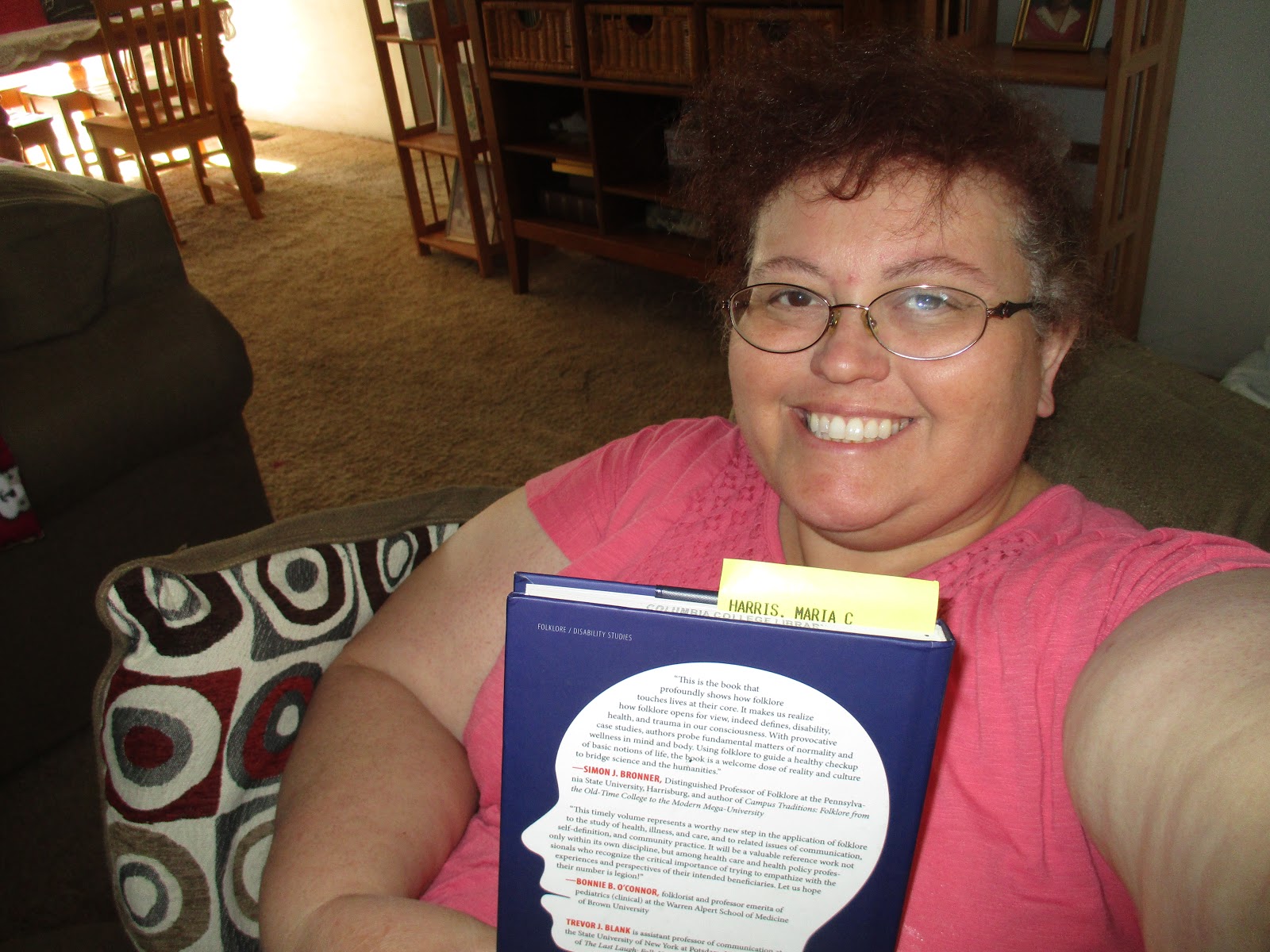
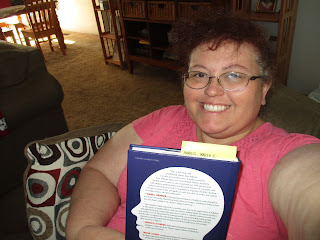 One nice change is that it took me much less time to get used to how I look. I think the first time around it took about three months before I was okay with looking the way I do. This time it only took about a week.
 There were also surprises, like seeing how much happier I looked after getting just a couple of hours of respite time. It kind of made me feel guilty, that it would affect me so much, but it did hit home how much I need it. I think it's visible.
 Recently I got another reminder as I posted an unsmiling picture and got far fewer likes and one gentle encouragement to smile. No one means any harm, and no one even caused any harm, but yeah, women are supposed to smile. We get it in public, and posting the selfies is a way of being public.
 But if this is about being a full and real person, I am not always wearing a radiant smile. I am an unpaid caretaker dealing with a progressive disease and my house is in foreclosure. I am sad and worried a lot. Though I acknowledge that my ability to frequently smile is noteworthy, and that my smile is good. Good teeth. I also haven't seen a dentist in about two years, which is a concern.
 I get tired, and I keep my sense of humor most of the time. but I need the freedom to be fully human: the good, the bad, and the ugly.
 (I didn't know the pillow was doing that to my nose until I saw the picture, but that happens sometimes. It's life.)
 There should still always be plenty of animal pictures.
(I'll get Mavis and Lilly in some shots eventually.)


http://www.shakesville.com/2018/01/365feministselfie.html
I have not been anywhere near as visible or active as her in anything, but her post resonated because I also feel the trend toward dehumanization, and dangers that come with it. I will write more about that later. I could see the value in asserting myself again as human and real and believing in the value of humanity and reality.




(I'll get Mavis and Lilly in some shots eventually.)
Subscribe to:
Posts (Atom)

 Posts